
Astronomers Discover a Possible Date for the Great War in the Mahabharata — Calculations Point to an Event 5,000 Years Ago
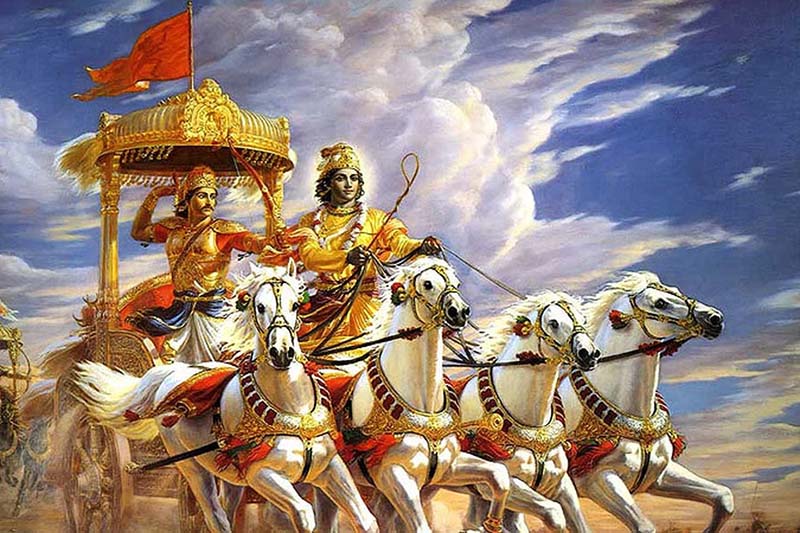
The ancient Indian epic Mahabharata may contain clues about events that took place long before the emergence of written history. A research team at the University of Calcutta developed a computer model to reconstruct the positions of celestial bodies described in the text before the great Battle of Kurukshetra. The results pointed to several possible dates, one of which proved particularly intriguing: around 3000 BCE. The researchers analyzed 14 passages from the epic mentioning eclipses, unusual planetary alignments, and celestial omens preceding the battle. They then compared these descriptions with astronomical models capable of calculating the positions of the Sun, Moon, and planets in the distant past. According to the authors of the hypothetical study, the closest match across several descriptions emerged for a period approximately 5,000 years ago.
Particular attention focused on a passage describing an unusual sequence of eclipses shortly before the war. The researchers attempted to determine whether such a combination of events could have been observed in the region of ancient Kurukshetra. Their model identified several potentially suitable periods, but none accounted for every detail in the text simultaneously. The most unexpected result was the apparent correspondence between certain calculated planetary configurations and descriptions traditionally interpreted as omens: the unusual position of Mars, the close apparent alignment of visible planets, and eclipses occurring within a relatively short period. The researchers suggested that some episodes might be based on actual astronomical observations that were later incorporated into the epic narrative.
If this interpretation were eventually supported by further evidence, it could offer a new perspective on how ancient Indians observed the sky and transmitted knowledge across generations. However, an astronomical coincidence does not prove that the war between the Pandavas and Kauravas actually took place during the calculated period. The text itself developed over centuries, and its descriptions of celestial events can be interpreted in different ways.
For now, the proposed dates remain working hypotheses. A potential next step would be to compare the astronomical calculations with archaeological evidence from the Kurukshetra region. This could help researchers determine whether the celestial episodes preserve memories of specific events or represent the symbolic language of an ancient epic.