
Einstein Left Unpublished Notes on Time in Ancient Indian Philosophy
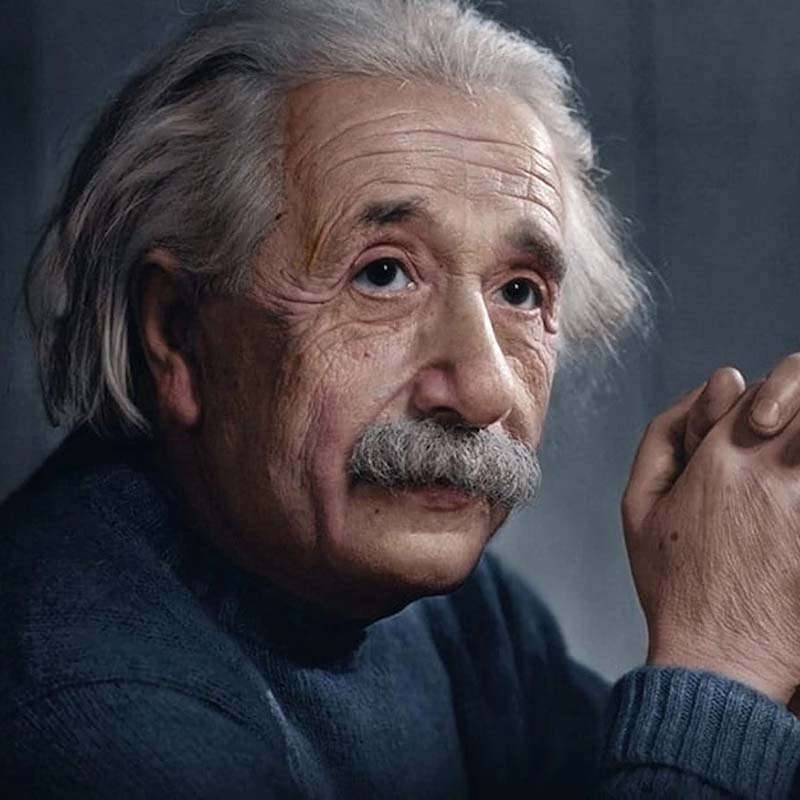
An unusual discovery in Switzerland has attracted the attention of researchers after historian of science Markus Keller announced that he had found seven handwritten pages believed to have belonged to Albert Einstein. The documents are dated between 1931 and 1934 and contain reflections on the nature of time, as well as terms drawn from ancient Indian philosophy. These include the Sanskrit words kala, meaning time, and yuga, associated with cosmic ages.
The manuscripts were found in a wooden case purchased at an estate sale in the city of Winterthur. The case had previously belonged to the family of a university lecturer who collected scientific correspondence and books on Asian philosophy. Alongside the pages bearing handwriting resembling Einstein's, the case contained a German-language book on Indian metaphysics published in 1932 and a letter mentioning a planned discussion about the relationship between physics and philosophy. Keller paid particular attention to one passage. In it, the author considers the possibility that human perception of time reflects only one level of reality, while the existence of the universe can be understood on a much broader scale. According to the historian, this idea echoes Indian philosophical concepts in which time is viewed not merely as a sequence of individual events, but as part of vast cycles of creation and destruction. The news quickly attracted the attention of collectors. One private buyer offered 420,000 Swiss francs for the entire archive. Keller declined the offer pending an independent examination and approached specialists at the University of Zurich to assess the documents. Researchers will need to study the handwriting, ink composition, and characteristics of the paper to determine whether they are consistent with the first half of the twentieth century. Initial assessments have produced mixed results. A handwriting specialist who examined copies of two pages identified features matching known examples of Einstein's writing, but stressed that photographs alone were insufficient to establish authenticity. The provenance of the manuscripts is another unresolved issue: researchers have yet to establish a continuous record of ownership that would trace the documents from their original owner to the present collection.
If the attribution is confirmed, the notes would offer a rare glimpse into Einstein's intellectual interests during a period when he continued to grapple with fundamental questions in physics. The scientist was genuinely interested in philosophical questions, but familiarity with ancient Indian ideas would not, by itself, demonstrate that he used them in developing his scientific theories. The archive's fate now depends on the results of the examination. Historians hope to establish not only whether the pages are authentic, but also how the writings of one of the world's most famous physicists ended up in the same collection as books on Indian metaphysics. If the documents prove genuine, they could reveal a little-known chapter in Einstein's intellectual life—and reopen the question of where scientific investigations of the universe end and philosophical attempts to understand its nature begin.