
Historic Homecoming: Netherlands Repatriates 1,000-Year-Old Chola Dynasty Copper Plates to India
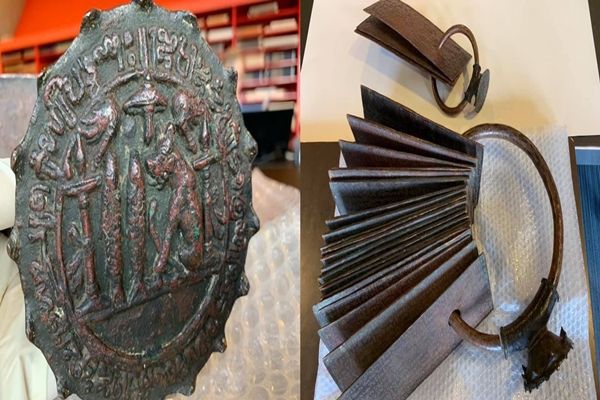
In a landmark milestone for India’s cultural diplomacy, the Government of the Netherlands has officially returned the historic 11th-century Anaimangalam copper plates to India. The repatriation ceremony took place in The Hague during Prime Minister Narendra Modi's bilateral visit, where Dutch Prime Minister Rob Jetten formally handed over the priceless royal charters.
Commonly referred to globally as the "Leiden Plates," the artifact had been preserved in the Asian Library vaults of Leiden University since 1862.
A Royal Record of Maritime and Religious Harmony
The returned artifact is a massive collection consisting of 21 large copper plates weighing approximately 30 kilograms. They are permanently fastened together by a heavy bronze ring and secured with the royal seal of Emperor Rajendra Chola I.
The inscriptions feature a bilingual format that provides rare insights into the administrative sophistication of the Chola Empire:
- The Sanskrit Section: Traces the divine genealogy of the Chola lineage.
- The Tamil Section: Records the practical administrative details of a massive land grant initiated by Emperor Rajaraja Chola I and formalized by his son, Rajendra Chola I.
The charter documents that the revenues of Anaimangalam village near the port town of Nagapattinam were assigned to support the Chudamani Vihara, a Buddhist monastery built by the Sailendra rulers of the maritime Srivijaya Empire (modern-day Indonesia).
Following the ceremony, Prime Minister Narendra Modi shared his thoughts on the historic repatriation:
"A joyous moment for every Indian! Chola Copper Plates dating back to the 11th Century will be repatriated to India from the Netherlands. We in India are immensely proud of the Cholas, their culture and their maritime prowess. I thank the Government of the Netherlands and Leiden University in particular."
Unwinding Centuries of Colonial Displacement
The journey of the plates to Europe reflects the colonial shifts in southern India. Around 1700, the artifact was acquired by Dutch missionary Florentius Camper when the Dutch East India Company (VOC) established control over the port of Nagapattinam. The plates were subsequently transferred to the Netherlands without the consent of their rightful custodians.
India’s Ministry of External Affairs (MEA) and the Archaeological Survey of India (ASI) intensified diplomatic efforts for their return in 2012. A major breakthrough occurred when UNESCO’s Intergovernmental Committee for Promoting the Return of Cultural Property validated India’s claim as the nation of origin.
Following a comprehensive provenance review, the Dutch Colonial Collections Committee concluded that the artifact constituted an "involuntary loss of possession," leading to the university's decision for an unconditional return.
Cultural Signficance and What Lies Next
External Affairs Ministry spokesperson Randhir Jaiswal described the return as "yet another step in the homecoming of Indian cultural artefacts from abroad."
Cultural enthusiasts and historians point out that the Leiden Plates represent far more than a standard ancient land deed. They serve as primary civilizational evidence of a Tamil empire that successfully balanced dominant regional military power with interfaith patronage, global maritime trade, and international diplomacy across the Indian Ocean. The plates are scheduled to be transferred to the ASI in New Delhi before returning to their ancestral home soil in Tamil Nadu.