
Pakistani Hindu Refugees Attend Ram Katha in India: “We Want Indian Citizenship”
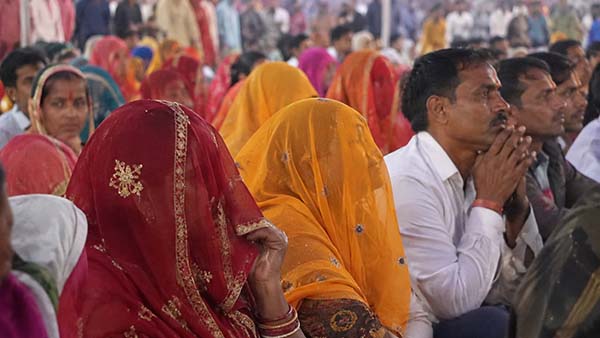
A Ram Katha, a religious discourse recounting the life of Lord Rama, is underway in Kunda, Uttar Pradesh, drawing large crowds of devotees. Among those attending are around 500 Hindu migrants from Pakistan who were specially invited to the event by local MLA Raghuraj Pratap Singh, popularly known as Raja Bhaiya.
The group travelled from Jodhpur in 10 buses. Three camps were set up for them in a mango orchard behind Benti Raj Bhavan, where organisers arranged food, drinking water and accommodation. Police personnel have also been deployed around the camps.
The guests were given seats near the front of the pandal, close to the VIP enclosure. Volunteers escorted the group as they made their way to the venue, helping maintain order and clear a passage through the crowd. Many of the devotees chanted “Jai Shri Ram” along the way. “We left everything behind” The invitation was the result of an initiative that began in 2024, when Raja Bhaiya visited Jodhpur and met Hindu migrants from Pakistan’s Sindh province. During that meeting, the refugees spoke about their migration, the difficulties of settling in India and the challenges of rebuilding their lives. Following the encounter, the MLA decided to invite them to religious events he organised.
Some of the attendees had moved to India several years ago, while others had arrived much earlier. Many are still waiting to obtain Indian citizenship.
Heeralaal, who arrived in India from Pakistan in 2018, spoke about his experience of attending the gathering.
“We left Pakistan in 2018. We never imagined in our lives that we would get an opportunity to meet Bageshwar Baba. Our hearts are filled with happiness. The best part was that he performed a havan with us. It felt as if our souls had been purified. All our needs are being taken care of here.”
Asked whether he would consider returning to Pakistan, Heeralaal said:
“We want to get Indian citizenship. This country is good. We left Pakistan for the sake of Sanatan Dharma. We have the right to worship here, but we cannot do so openly there. We have to worship inside our homes out of fear. There is discrimination in children's education too. We send our younger daughters to school, but once they grow older, we are afraid to send them. You must be seeing on news channels what is happening to Hindus in Pakistan.” Women continue to wear traditional veils Among the women attending the Ram Katha were several dressed in traditional clothing, with long veils covering their faces. Their attire caught the attention of reporters, who asked why they continued to wear the coverings in India.
One woman explained that many Hindu women in Pakistan also cover their faces when leaving home. She said the practice had become customary over time and was part of the culture they had grown accustomed to.
Sita Devi, 40, said the visit to Kunda had been a special experience for her.
“We are very happy to have come to Kunda. We had seen and listened to Bageshwar Dham on our mobile phones, but today we are seeing him in person for the first time. Nobody has ever invited us and given us front-row seats like VIPs before. I don't think we will ever get such an opportunity again.”
She also noted that life in Pakistan had not always been defined solely by religious difficulties.
“We do not have any major problems there, but inflation is very high. People do not even have enough money to buy everyday essentials.”
Another attendee, Radha, added that veiling was part of their culture and tradition, which was why they continued to wear it during visits to India. “We feel safe here” Some families moved to India without being able to immediately secure permanent residency. Among them is Akash’s family, which arrived in the country on tourist visas in 2018 and subsequently stayed.
Akash said Hindus in Pakistan faced discrimination and that some families feared for their safety. He said his family had encountered bureaucratic difficulties after moving to India, including having to make repeated visits to police stations.
“There is a lot of discrimination between Hindus and Muslims in Pakistan. People are raped on the basis of their religion. Nothing like that happens here, which is why we left our homes and land behind and came to India. However, we are facing some difficulties at the moment because we have to keep visiting police stations due to our arrival from Pakistan. Teachers at school treat us well, but the students studying with us do not consider us one of their own.”
Akash also said some of his relatives remained in Pakistan and were still in contact with the family. According to him, they too would like to move to India if they are able to obtain visas.
“We feel safe here.” Religious ceremonies and visits to holy cities Before the Ram Katha began, the refugees took part in a havan and other religious rituals at Benti Raj Bhavan. Dhirendra Shastri, known as Bageshwar Baba, participated in the ceremony, sitting at the yajna altar during the ritual.
For many of the guests, attending the Ram Katha was not only a religious occasion but also an opportunity to feel part of a wider community. Some said they had never attended an event of such scale before and were particularly grateful for the opportunity to sit close to the stage.
Suresh, around 50, said he had never experienced anything like it.
“I am around 50 years old. I have never had the opportunity to attend such an event in my life. I can only thank Raja Bhaiya.
On 20 November, that is, tomorrow, after the Ram Katha concludes, we will visit the Sangam in Prayagraj. We will take a dip in the Ganga. After that, we will visit Baba Vishwanath in Varanasi and seek the blessings of Ram Lalla in Ayodhya. Then we will return to Jodhpur.” Thousands of migrants await citizenship Jodhpur is home to an estimated 17,000 to 18,000 migrants from Pakistan, living across 21 settlements. Their communities are located in the Sursagar, Mandore, Kaliberi and Chokhan areas.
Some migrants who arrived in India decades ago have already obtained citizenship. However, those who came more recently continue to face difficulties with the process. According to the migrants, most arrived after 2014, which has also affected their ability to secure citizenship.
For those attending the Ram Katha, the trip to Kunda has offered an opportunity not only to take part in religious ceremonies but also to share their stories, hopes for the future and aspirations to make India their permanent home.