
Tat Tvam Asi ("Thou Art That"): The Grand Equation of Advaita
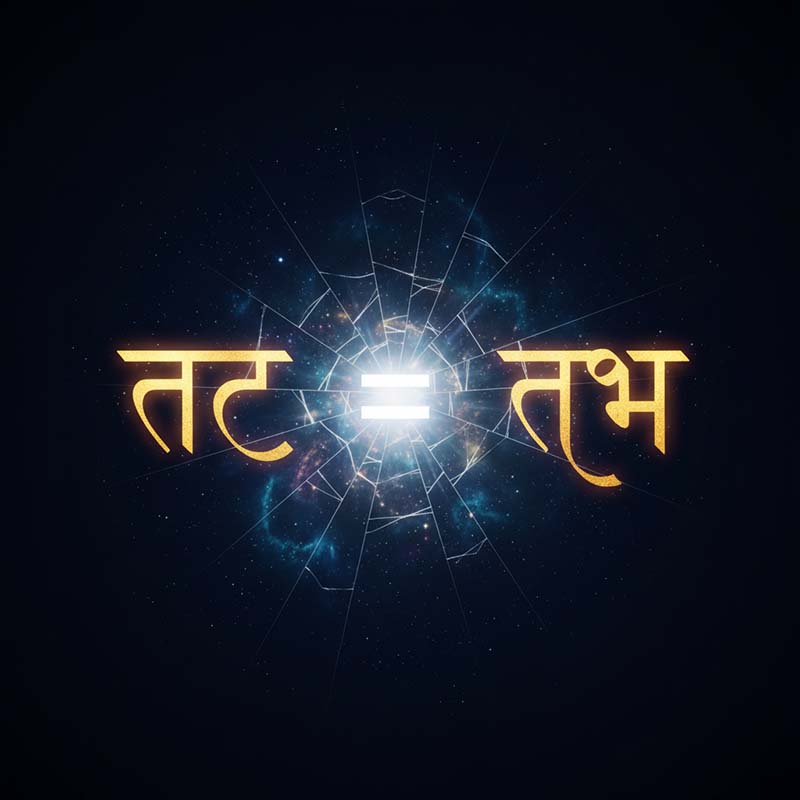
Among the vast literature of the Upanishads, certain concise phrases pierce directly to the heart of reality like intellectual lightning bolts. These are the Mahavakyas, the "Great Utterances" of non-dual philosophy. Foremost among them is Tat Tvam Asi—literally translated from Sanskrit as "Thou Art That." Found in the Chandogya Upanishad, this formula is delivered by the sage Uddalaka Aruni to his son, Shvetaketu, as the ultimate key to existence. It is not a poetic metaphor, nor is it a religious command. It is a precise, radical equation meant to entirely dismantle a seeker's distorted perception of identity and the universe.
To understand the mechanics of this equation, one must unpack its philological structure. The statement consists of three profound terms: Tat ("That"), Tvam ("Thou"), and Asi ("Art/Is").
In the ancient dialogue, "That" refers to Brahman—the unmanifest, infinite, and changeless ground of all being, the source from which entire galaxies erupt and into which they return. "Thou" refers to the intimate, inner self of the listener—the subjective sense of "I am." By placing the verb "Art" between them, the Upanishad forces an immediate, shocking identity between the individual and the cosmic whole. It asserts that your innermost essence is not merely connected to the Divine, but is fundamentally, completely identical to it.
The immediate obstacle to accepting this equation is the human ego. When an ordinary person hears the word "Thou," they immediately look at the mirror. They identify "Thou" with their physical body, their changing emotional states, their social status, and their transient thoughts.
Advaita Vedanta deconstructs this error through a process of systematic elimination. The philosophy points out that the body is merely a biological suit, subject to aging and decay. The mind is a constantly shifting river of thoughts, memories, and neuroses. You cannot be that which you observe; you are the one doing the observing.
The true "Thou" is not the psychological ego (ahamkara), but the Atman—the silent, unchanging witness-consciousness (sakshi) that sits behind the eyes, illuminating every experience without being modified by it.
Once the true nature of "Thou" is rescued from the trap of the ego, and the true nature of "That" is rescued from the trap of a distant, anthropomorphic God sitting in the heavens, the artificial barrier between Creator and Creation completely collapses.
In mainstream religious thought, man and God are separated by an unbridgeable metaphysical gulf. Advaita Vedanta reveals that this separation is a trick of perspective caused by Maya (cosmic illusion).
When the equation Tat Tvam Asi is fully realized, it becomes clear that there are not two separate entities trying to touch each other. The apparent duality of the world dissolves into a singular, indivisible ocean of pure Consciousness (Chit). The wave on the surface of the sea does not need to travel to find the ocean—it is, and always has been, nothing but water. In the same way, the individual seeker awakens to the sublime realization that they are the very Reality they have been searching for all along.