
The Ontology of Time: Why "Past" and "Future" Do Not Exist in Absolute Reality
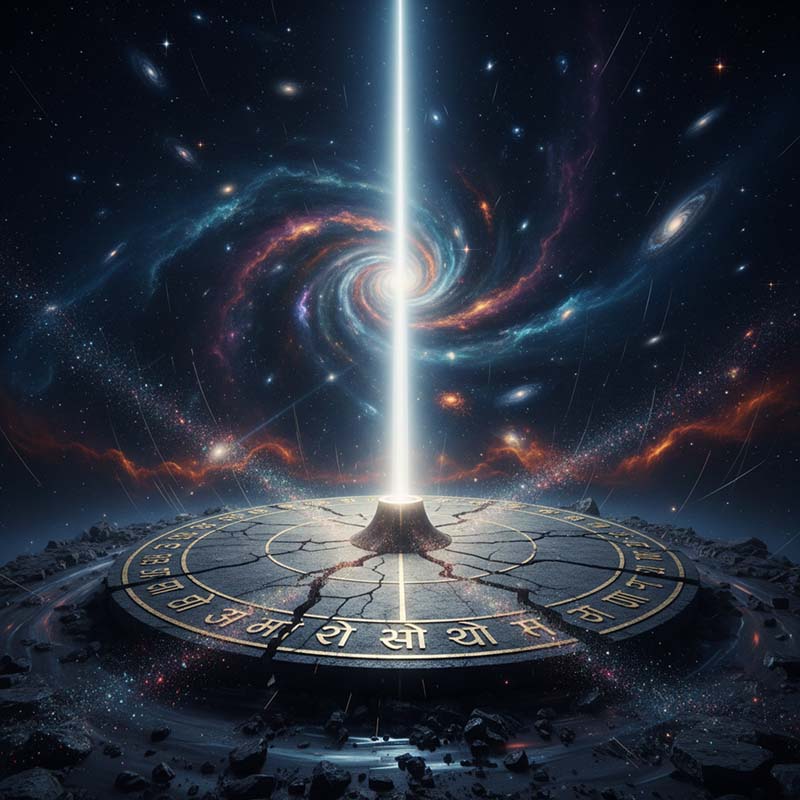
The human mind is fundamentally conditioned by the concept of linear time. We are accustomed to perceiving our existence as a continuous movement along a straight line—from an unrecoverable past, through a fleeting present, into an uncertain future. This mental construct is so deeply embedded in our psyche that it appears to be an objective characteristic of the universe itself. However, the highest metaphysics of Hinduism, particularly the radical non-dualism of Advaita Vedanta, offers a profoundly different, deconstructive view of the nature of chronos. From this vantage point, linear time is nothing more than a category of perception, manufactured by the limited human mind (manas) under the influence of cosmic illusion (maya).
In the philosophical schools of India, the concept of time is intimately tied to Triputi—the triad of perception, which in this context divides the singular reality into three temporal layers: past (bhuta), present (vartamana), and future (bhavishyat). The highest philosophical schools subject this triad to rigorous critique. The past no longer exists; it remains only as fading mental imprints and memories within our intellect. The future has not yet arrived; it is merely a projection of our hopes, fears, and imagination. Consequently, two-thirds of what we call time lacks any independent ontological status—it exists exclusively within human consciousness. The present, squeezed between these two non-existences, shrinks in linear perception to an elusive point approaching zero. By attempting to lean on such time, humanity builds its reality upon an illusory foundation.
From the perspective of Advaita Vedanta, absolute reality belongs solely to the Supreme (Brahman), described as changeless, indivisible consciousness. Brahman exists beyond time (kalatita). From this arises the most critical metaphysical definition of Eternity. In Indian thought, Eternity is not an infinite, endlessly stretching duration of time; it is not billions of years following one after another. True Eternity (Nitya) is the complete, radical absence of time altogether. It is a state of perpetual "Now," where the categories of "before" and "after" do not apply, and where there is no alteration, decay, or origination.
Time appears only when the singular Consciousness, influenced by Maya, begins to identify with a limited mind and body. The mind, incapable of grasping the whole of reality simultaneously, is forced to fragment it into sequential events, thereby creating the illusion of time's flow. Thus, past and future are merely the framework by which the human intellect organizes its restricted experience. In absolute reality (Paramarthika), time does not exist; there is only an eternal, immovable Presence, within whose ocean entire universes are born and dissolve, remaining forever within the changeless instant of Eternity.